
Which Glass Has More Water? The Surprising Truth Explained

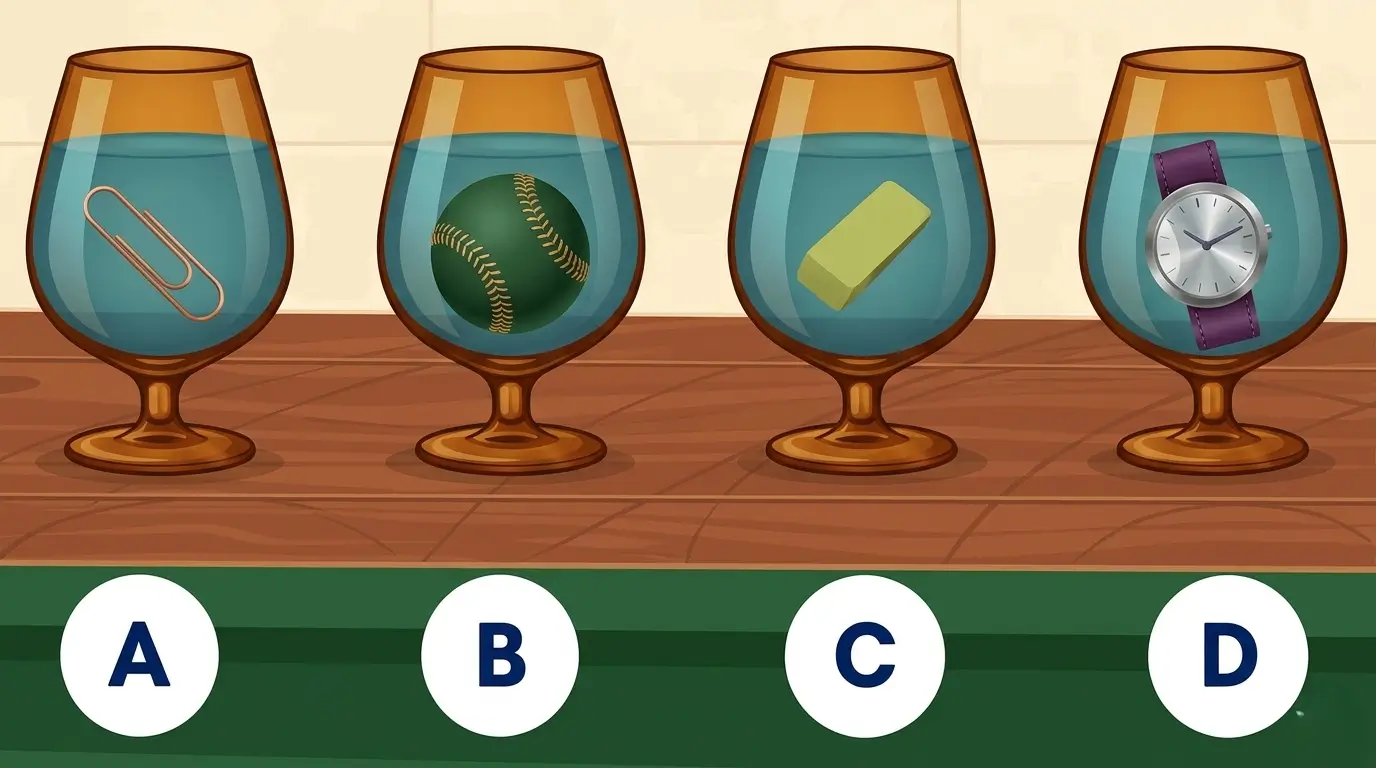
Glass puzzles continue to confuse people online because the answer seems obvious at first glance, yet one tiny detail completely changes the result.
A simple image showing four different glass containers filled with water has become one of the internet’s most talked about visual riddles.
While many people instantly choose the wrong answer, the real solution depends on understanding a basic scientific principle that most people overlook in the first few seconds.
At first, the challenge looks almost too easy.
Four containers labeled A, B, C, and D appear to contain nearly the same amount of liquid. Each glass also contains a different object placed inside the water. One has a paperclip, another has a baseball, another includes an eraser, and the last contains a wristwatch.
The question sounds simple enough:
Which glass actually contains the most water?
Many people answer quickly without thinking too deeply about it. Since the water levels appear nearly identical, the brain naturally assumes each glass contains roughly the same amount of liquid. That immediate reaction is exactly why the puzzle has spread so quickly online.
The image tricks the eyes into focusing only on what is visible at the surface.
But the real answer has nothing to do with appearances.
The puzzle is really about physics.
To understand the correct answer, people need to think about displacement. Every object inside a glass takes up physical space. The larger the object, the less room remains for water.
That single detail changes everything.
Glass A contains a paperclip. Because the paperclip is extremely small, it displaces very little water inside the container. That means Glass A actually holds more water than the others.
The other containers hold larger objects that push more water out of the available space.
Glass B contains a baseball, which takes up a significant amount of room. Even though the water level may appear similar to the others, there is much less actual water inside because the baseball occupies such a large portion of the container.
Glass C includes an eraser. The eraser takes up more space than the paperclip but less than the baseball. Meanwhile, Glass D contains a wristwatch, which also displaces a noticeable amount of water.
Once people realize this, the answer suddenly becomes obvious.
Still, many viewers get the puzzle wrong the first time.
That is what makes the challenge so interesting.
The human brain often relies on shortcuts when processing visual information. Instead of carefully analyzing every detail, people tend to make quick judgments based on appearance alone. In this case, the nearly equal water levels encourage viewers to ignore the size of the objects sitting inside each glass.
That mental shortcut leads many people directly to the wrong answer.
The puzzle became especially popular online because it creates a surprising moment of realization. At first, many people feel confident about their choice. Then, after understanding displacement, they suddenly recognize the mistake.
That instant shift from certainty to surprise is deeply satisfying for many viewers.
Over time, the puzzle evolved into something more than just a science riddle.
People began treating the image like a personality test.
Different interpretations appeared online, suggesting that the first glass a person chooses might reveal something about the way they think or process information.
While these personality descriptions are not scientific facts, they became part of the entertainment surrounding the puzzle.
People who immediately chose Glass A are often described as detail oriented thinkers who prefer logic over assumptions. According to the playful interpretation, these individuals carefully analyze situations before making decisions and tend to notice things others miss.
Many descriptions portray them as patient observers who rely more on evidence than emotion.
People who selected Glass B are often described differently.
According to the online interpretations, those who choose the baseball glass may trust first impressions strongly and rely heavily on instinct. They may prefer making fast decisions and feel comfortable acting quickly without overthinking every detail.
Meanwhile, those drawn toward Glass C are sometimes described as balanced thinkers. These individuals are often portrayed as people who combine creativity with logic and try to consider multiple possibilities before reaching a conclusion.
Glass D also developed its own personality interpretation.
People who choose the wristwatch glass are sometimes viewed as emotionally intuitive or abstract thinkers who focus on symbolism and deeper meaning rather than strict logic.
Again, none of these descriptions are based on real psychological science.
They simply add another layer of fun to the puzzle.
Still, the reason this glass challenge became so addictive goes far beyond personality labels.
The puzzle highlights something surprisingly important about human perception.
People often assume that what they see immediately must be true.
In reality, the brain constantly simplifies information to save time and energy. Humans make thousands of rapid judgments every day, and most of those decisions rely on patterns, assumptions, and visual shortcuts.
Usually, those shortcuts work well enough.
But sometimes, they fail.
This puzzle is a perfect example.
The image appears straightforward because the water levels look almost equal in every glass. That visual similarity encourages the brain to stop analyzing further. Many viewers never pause to think about how much space the objects occupy.
The brain fills in missing details automatically.
That process happens constantly in everyday life.
People often judge situations based on surface level impressions before understanding the full picture. A loud opinion may seem more important than a quiet one. A confident person may appear more knowledgeable than someone who speaks carefully. Something large and obvious may attract attention even when the smaller detail matters more.
The glass puzzle reflects that tendency perfectly.
The smallest object inside the containers turns out to be the key to the entire answer.
A tiny paperclip changes everything.
That surprising twist is one reason visual riddles spread so rapidly online.
People enjoy being challenged in a way that feels clever rather than frustrating. The puzzle does not require advanced math or complicated scientific knowledge. Instead, it depends on observation and reasoning.
Once viewers understand the logic, the answer feels satisfying.
Many people immediately share the puzzle with friends or family members to see whether others will fall for the same visual trick.
That social aspect helped the image become viral.
Comment sections quickly filled with debates.
Some people argued strongly for the wrong answer before eventually realizing the mistake. Others insisted the solution was obvious from the beginning. The discussion itself became part of the entertainment.
Visual puzzles like this also create a strong emotional response because they challenge confidence.
Nobody enjoys realizing they missed an important detail.
At the same time, discovering the answer can feel rewarding.
That emotional combination keeps people engaged.
The simplicity of the image also contributes to its popularity.
There are no complicated instructions. Anyone can understand the question within seconds.
Which glass has the most water?
That is all people need to know.
Because the challenge feels accessible, viewers of all ages can participate. Children, teenagers, and adults can all attempt to solve it without needing specialized knowledge.
The puzzle also works well on social media because it immediately encourages interaction.
People naturally want to comment with their answer.
Once others disagree, the conversation grows even larger.
Many online users become emotionally attached to their first instinct and defend it passionately before eventually reconsidering the science behind the image.
The fascinating part is how strongly the brain trusts visual assumptions.
Even after learning about displacement in school, many adults still ignore it during the first glance at the puzzle.
That reaction demonstrates how quickly the mind prioritizes appearance over careful reasoning.
The glass challenge reveals how perception can sometimes overpower logic during the first few seconds of decision making.
It also demonstrates how powerful visual design can be.
The creator of the puzzle intentionally arranged the containers so the water levels appeared nearly identical. That design encourages viewers to focus only on the visible surface rather than the hidden volume occupied by the objects.
A slightly different image might not fool people nearly as effectively.
The balance between simplicity and deception is what makes the puzzle successful.
The science itself remains extremely straightforward.
When an object is placed inside a container of liquid, it pushes aside a certain amount of space. Larger objects displace more liquid than smaller ones.
Since the paperclip occupies the least space, the corresponding glass contains the greatest amount of actual water.
That basic principle explains the entire puzzle.
Yet despite how simple the explanation becomes afterward, many people still experience a moment of shock when they hear the answer.
That reaction highlights an important truth about human thinking.
People often believe they are observing reality objectively, but perception is heavily influenced by expectation and habit.
The mind prefers efficiency.
Instead of analyzing every situation deeply, the brain frequently chooses the fastest interpretation available.
Most of the time, that strategy helps people navigate daily life efficiently.
However, puzzles like this expose the weaknesses in those mental shortcuts.
The glass image encourages viewers to slow down and reconsider what they think they know.
That lesson extends beyond internet riddles.
In real life, appearances can easily mislead people.
Someone who seems impressive at first glance may lack substance beneath the surface. Meanwhile, quieter individuals who attract less attention may possess greater depth, intelligence, or understanding.
The puzzle subtly reflects that broader idea.
The largest object in the image does not represent the greatest amount of water.
In fact, the opposite is true.
The baseball appears dominant because of its size, yet it leaves the least room available inside the glass.
The paperclip barely attracts attention, but it allows the container to hold more actual liquid.
That contrast feels surprisingly symbolic to many viewers.
It reminds people that the most obvious answer is not always the correct one.
The puzzle also demonstrates the importance of critical thinking.
Taking an extra moment to examine details can completely change the outcome of a decision.
Rushing toward conclusions based purely on instinct may lead people in the wrong direction.
At the same time, the puzzle does not suggest instinct is always bad.
Fast thinking can be useful in many situations.
The challenge simply reveals that some problems require deeper observation.
That balance between instinct and analysis is part of what makes the puzzle so relatable.
Almost everyone has experienced moments where assumptions turned out to be wrong.
The glass image captures that experience in a simple and entertaining way.
It is also interesting how strongly people identify with the personality descriptions connected to the puzzle.
Even though the interpretations are not scientific, many viewers still enjoy reading what their answer supposedly says about them.
That reaction reflects another aspect of human psychology.
People naturally search for meaning and self understanding.
Even playful internet quizzes can feel engaging because they offer insight into personality, decision making, or emotional habits.
The glass challenge combines several appealing elements at once.
It includes visual deception, scientific reasoning, social debate, and personality interpretation.
Together, those ingredients create a puzzle that people want to share repeatedly.
The image also proves that complicated entertainment is not always necessary.
Sometimes the simplest ideas spread the fastest.
A few containers, a few objects, and one carefully designed question managed to capture attention across the internet.
That simplicity makes the puzzle memorable.
Long after seeing the image, many people still remember the surprising answer.
Some even begin analyzing similar situations differently afterward.
Once someone understands displacement through this example, they may notice the principle more often in everyday life.
That educational element adds extra value to the puzzle.
Without feeling like a lesson, the image teaches viewers a real scientific concept in a memorable way.
Many traditional educational explanations fail to create that level of engagement.
People remember experiences more strongly when surprise and emotion are involved.
The glass challenge uses both.
First, viewers feel confident.
Then they feel surprised.
Finally, they experience satisfaction after understanding the logic.
That emotional sequence helps the information stick.
The puzzle also encourages curiosity.
Instead of simply presenting facts, it invites people to solve the problem themselves.
That active participation keeps the brain engaged much more effectively than passive reading.
It is one reason riddles and visual challenges remain popular year after year.
Humans enjoy testing perception and reasoning skills.
The glass puzzle may appear small and simple, but it reflects several fascinating aspects of human behavior.
It shows how quickly people form assumptions.
It reveals how strongly the mind trusts visual information.
It demonstrates the importance of overlooked details.
And perhaps most importantly, it reminds people to pause before accepting the obvious answer.
In the end, the correct solution remains clear.
Glass A contains the most water because the paperclip takes up the least amount of space.
Every other object displaces more water inside its container.
That tiny detail changes the entire puzzle.
Even so, many viewers still choose another answer during their first attempt.
That is exactly why the challenge continues spreading online.
People enjoy discovering how easily perception can be fooled.
The next time someone shares this glass puzzle, many viewers will probably feel confident immediately.
They will glance quickly at the image and trust their first instinct.
Then, moments later, they may realize the truth was hidden inside the smallest detail all along.
And that realization is what makes the puzzle so satisfying.
Sometimes, the answer is not about what stands out the most.
Sometimes, the answer depends on what quietly occupies the least space.
That is the surprising truth behind the viral glass challenge that continues confusing thousands of people online.