
Bikini Shocked the World but Changed Fashion Forever


Bikini history is filled with controversy, rebellion, and dramatic cultural change. What seems ordinary on beaches today was once considered dangerous, immoral, and even illegal in several countries.
Long before the bikini became a fashion staple, women faced strict rules about what they could wear while swimming, and breaking those rules often came with humiliation or punishment.
At the beginning of the 20th century, swimwear looked nothing like modern designs. Women were expected to wear heavy wool garments that covered nearly the entire body.

These swimsuits were uncomfortable, difficult to swim in, and created more concern about modesty than practicality.
Beaches across the United States enforced strict dress codes, and many communities treated exposed skin as a public scandal.
Some beaches took these rules extremely seriously. According to authors Kathleen Morgan Drowne and Patrick Huber, Chicago’s Clarendon Beach even hired tailors to alter swimsuits that were considered too revealing.
If a hemline appeared too short or sleeves showed too much skin, adjustments were made immediately. The goal was clear: maintain strict standards of decency at all times.
Other places enforced similar restrictions. In 1915, Coney Island reportedly banned bathing socks if they exposed what officials described as “dimpled knees.”
In Washington, DC, beach police carried tape measures to inspect swimwear. The atmosphere around swimming was heavily controlled, and public beaches became places where appearance was monitored almost as closely as behavior.
The push toward modern swimwear started slowly. In 1907, Australian swimmer Annette Kellerman challenged accepted standards by wearing a fitted one piece swimsuit instead of bulky pantaloons.
Her outfit revealed her arms, neck, and legs, something that shocked many people at the time.
Kellerman was already famous for her swimming ability and became known as “The Australian Mermaid.” She spent years challenging outdated expectations placed on women.
According to her own account, police arrested her because authorities considered her swimsuit indecent, although no official records confirming the arrest have ever been found.
Whether the arrest happened exactly as described or not, the story spread rapidly and created headlines. Suddenly, conversations about women’s swimwear were happening everywhere.
Kellerman’s choice forced people to confront changing ideas about freedom, movement, and public morality.

The popularity of her swimsuit grew surprisingly fast. Women wanted swimwear that allowed them to move comfortably rather than struggle under heavy layers of fabric.
Eventually, Kellerman launched her own swimwear line, and the fitted one piece became widely known as the “Annette Kellerman.” It marked an important step toward the evolution of the bikini decades later.
During the 1920s, fashion began changing across society. The flapper era encouraged women to experiment with shorter dresses, looser silhouettes, and a more independent lifestyle.
Those same ideas slowly reached beach fashion as well.
A rebellious group from California called the “skirts be hanged girls” pushed for practical swimwear that women could actually swim in comfortably.
Their movement represented more than fashion trends. It reflected growing frustration with restrictive expectations placed on women’s bodies and daily lives.
Swimsuits gradually became more fitted and functional. Women still covered much of their bodies compared to modern standards, but attitudes were beginning to shift.
Beaches slowly became spaces where freedom of movement mattered more than rigid modesty rules. Even then, however, society had not yet seen the full cultural storm that the bikini would eventually create.
That turning point arrived in 1946 when French engineer Louis Réard introduced the bikini.
Unlike previous swimsuits, this two piece design exposed the navel and showed far more skin than most people considered acceptable. The reaction was immediate and explosive.
The timing of the bikini’s debut also added to its reputation. Just days earlier, the United States had conducted a nuclear test at Bikini Atoll in the Pacific.
Many historians believe Réard chose the name because he expected the swimsuit to have a similarly explosive effect on society and fashion culture.
The bikini quickly became one of the most controversial fashion items in modern history. Beaches across the United States banned it almost immediately.
In Europe, resistance was just as strong. France prohibited bikinis on certain beaches in 1949, while Germany banned them from many public pools for decades.
Religious and political groups also attacked the bikini aggressively. Pope Pope Pius XII declared the swimsuit sinful, and countries including Spain, Portugal, Belgium, and Italy introduced nationwide restrictions. Communist critics labeled the bikini a symbol of capitalist excess and moral decline.
In 1952, Australian model Ann Ferguson was reportedly asked to leave Surfers Paradise because her Paula Stafford bikini was considered too revealing.
Incidents like these helped strengthen the bikini’s rebellious image. For many women, wearing one became an act of defiance as much as fashion.
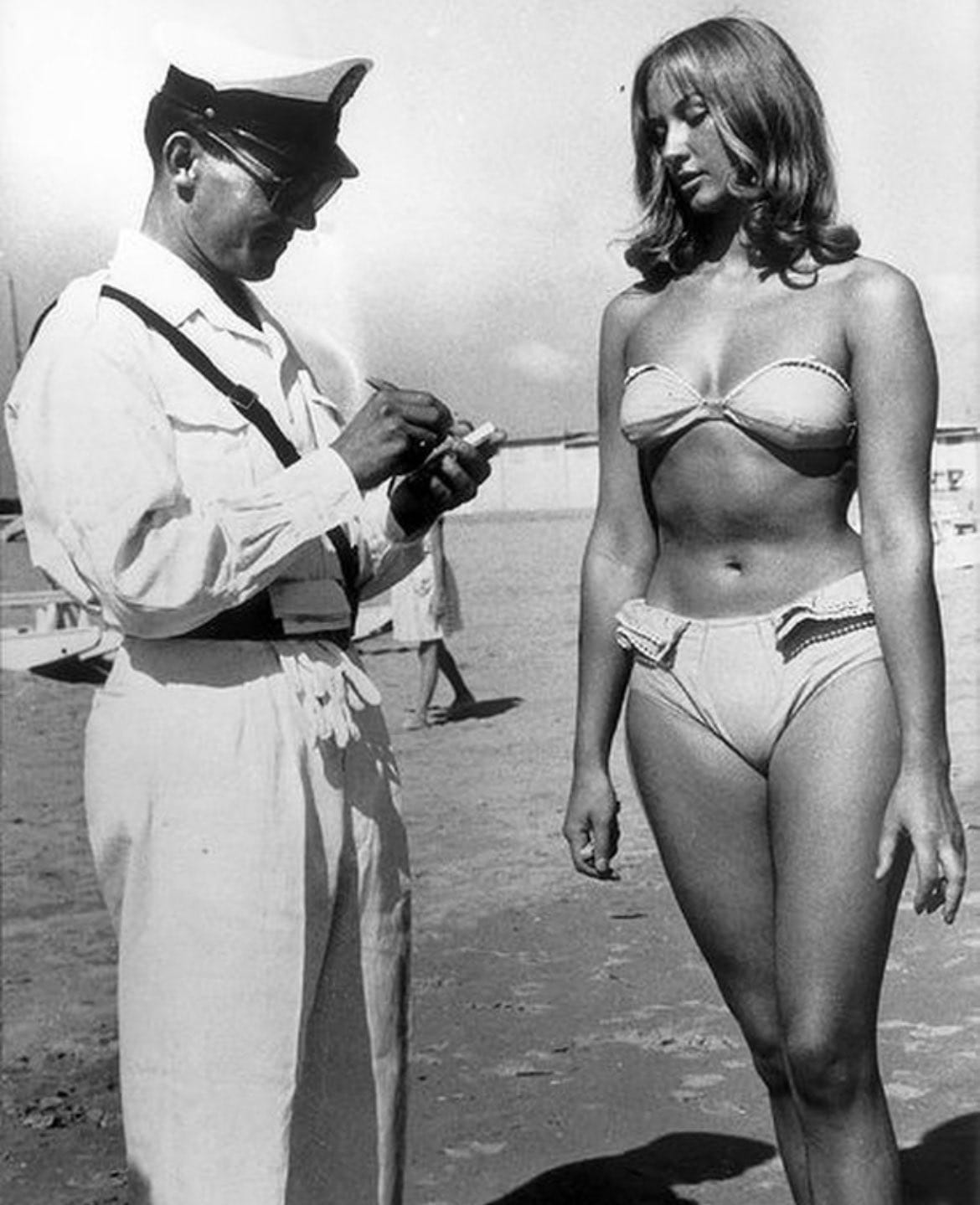
One famous photograph captured this cultural tension perfectly. The black and white image shows a man in uniform standing beside a young woman wearing a bikini on a beach in Italy.
Over the years, social media users claimed the photo showed a police officer issuing a fine simply because of her swimsuit.
The image became viral online, especially after a Reddit post in 2023 gained tens of thousands of reactions.
Many viewers saw the photograph as proof of how aggressively authorities once policed women’s clothing choices. Yet the real story behind the image remains uncertain.
Although the photograph itself appears authentic, historians have never fully confirmed the context. Some believe the scene may have been staged using actors or models.
Others think the officer could have been speaking to the woman for an unrelated reason entirely.
Still, the image reflected a genuine reality from that era. Gianluca Braschi, director of the State Archives of Rimini, confirmed that Italy did have laws regulating swimwear during that period.
A 1932 law prohibited bathing publicly in indecent swimwear, though enforcement varied significantly depending on the region and situation.
The uncertainty surrounding the photograph almost makes it more powerful. People continue sharing it because it represents a larger truth about the bikini and the intense reactions it provoked worldwide.
Even without knowing every detail, the image captures a moment when a swimsuit became part of a global cultural battle.
By the 1960s, attitudes toward the bikini slowly started changing. Social norms became less rigid, younger generations challenged conservative traditions, and fashion grew increasingly bold. Even so, resistance remained strong in many places.
Hollywood played an important role in shaping public opinion. The Hays Code, enforced in American films beginning in 1934, allowed two piece outfits but banned visible navels on screen.
Religious watchdog groups also pressured studios to avoid showing bikinis in movies altogether.
Despite those restrictions, major film stars gradually transformed the bikini into a symbol of glamour and confidence. Marilyn Monroe, Brigitte Bardot, and Ursula Andress helped redefine beauty standards for an entire generation.
Few people influenced bikini culture more than Brigitte Bardot. In her breakout film The Girl in the Bikini, Bardot transformed the swimsuit into a cultural statement rather than just beachwear.
Her carefree image, tousled hair, and relaxed confidence fascinated audiences worldwide.
The film emphasized her connection with the beach, sun, and ocean, but it also centered heavily on the bikini itself.
Bardot became one of the first actresses to make the swimsuit part of a character’s identity and storytelling. She helped turn the bikini into something aspirational rather than scandalous.
Another defining moment came when Ursula Andress appeared in Dr. No wearing a white bikini while emerging from the sea.
The scene became instantly iconic because it combined beauty with confidence and strength. Audiences did not just see glamour. They saw power and self assurance.
By the 1970s, the bikini had fully entered mainstream culture. Designs became increasingly revealing, with string bikinis and thong styles gaining popularity.
Men’s swimwear also became smaller and more relaxed as older modesty standards faded from public life.
Today, swimwear exists in countless styles, ranging from full coverage one pieces to minimal bikinis. Modern fashion focuses far more on comfort, self expression, and personal choice than strict moral rules. Conversations about body positivity and inclusivity have also reshaped how people view beachwear.
The bikini’s journey from banned garment to cultural symbol says a great deal about changing attitudes toward freedom, gender, and identity.
What once sparked outrage now represents confidence and individuality for many people around the world.
Looking back, it is remarkable how much controversy surrounded such a small piece of fabric. Yet the bikini was never really just about clothing.
It became part of a larger fight over who gets to decide how women should look, behave, and express themselves in public.