
Robot Runs 100m Faster Than Usain Bolt, Then Slams Into a Wall

For more than 15 years, Usain Bolt has owned one of the most famous records in sport. His astonishing 9.58-second 100m sprint in Berlin in 2009 remains the official world record, and no human has managed to beat it since.
A robot, however, apparently had other plans.
A humanoid machine has reportedly covered 100 metres in just 9.39 seconds, making it 0.19 seconds faster than Usain Bolt’s legendary run.
There was only one problem.
It didn’t seem to know how to stop.
The bizarre moment happened during the second World Humanoid Robot Games in Beijing, where robots from around the world competed in everything from running and soccer to weightlifting and real-world work challenges.
One of the stars of the event was Tiangong Ultra, a two-legged humanoid robot developed by Beijing-based X-Humanoid, also known as the Beijing Humanoid Robot Innovation Center.
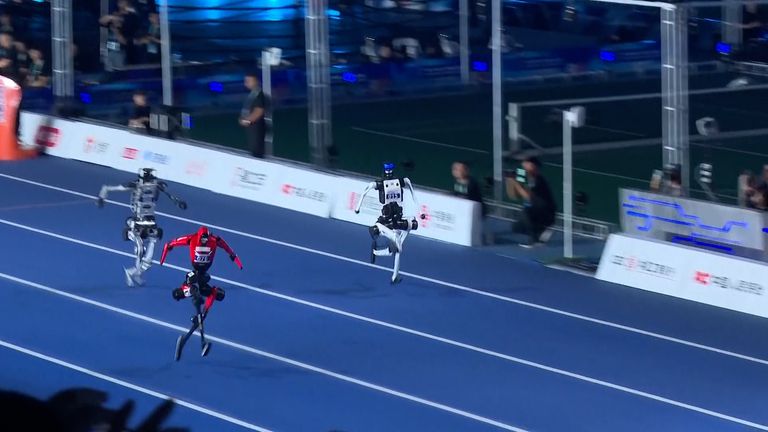
During a preliminary 100m heat, Tiangong Ultra raced down the track and crossed the finish line in 9.39 seconds.
For comparison, Usain Bolt’s 100m world record stands at 9.58 seconds.
That meant the machine had covered the distance nearly two-tenths of a second faster than the quickest officially recorded human 100m performance.
Even stranger, Tiangong Ultra wasn’t the only robot to do it.
Earlier in the race, another machine called Lightning, developed by Honor, had actually been ahead. Tiangong Ultra eventually caught up and passed it near the finish line.
Lightning still finished in an impressive 9.47 seconds.
So, at least according to the reported race times, two robots managed to cover 100 metres faster than Usain Bolt’s world-record mark.
That’s when things got messy.
Crossing the finish line is one thing. Realizing the race is over is apparently another.
After completing their sprints, neither robot managed to slow down smoothly. Both machines continued racing toward a large padded barrier positioned beyond the finish.
Tiangong Ultra smashed into the cushioning and stumbled toward the side of the track.
Lightning wasn’t so lucky.
It crashed into the barrier, fell to the ground and was eventually carried away.
The scene made for a pretty funny contrast. The robots had enough engineering behind them to reach extraordinary speeds on two legs, yet something humans do almost automatically after a sprint proved considerably more difficult.
Usain Bolt, it seems, still has them comfortably beaten when it comes to applying the brakes.
The 100m race was just one small part of a much larger event.
The five-day World Humanoid Robot Games reportedly brought together 2,056 robots from 666 teams across 16 countries.
There were 51 events in total. Thirty focused on sports, while another 21 tested robots in tasks closer to situations they might encounter outside a competition.
Some of the machines played soccer and table tennis. Others tried weightlifting and tug of war. There were even dancing and Tai Chi competitions.
The robots were also put through more practical tests involving factory work, restaurant service and emergency response.
The idea was not simply to see which robot could run fastest. Events like these offer developers a chance to test balance, movement, coordination, decision-making and recovery in unpredictable situations.
And Tiangong Ultra’s spectacular finish demonstrated why those details matter.
Running quickly in a straight line is impressive. Being able to control that speed, react to the environment and safely stop is another engineering problem entirely.
Humans rarely think about how complicated this is.
A sprinter crossing the finish line doesn’t immediately freeze in place. The athlete gradually reduces speed while maintaining balance and adjusting each stride. The brain, muscles and nervous system make those corrections almost instantly.
For a humanoid robot, those movements have to be engineered.
That makes the sight of a robot beating Usain Bolt’s time before crashing into a wall both impressive and slightly ridiculous.
There is also one very important detail here.
Usain Bolt has not lost his world record.
His 9.58-second performance remains the official men’s 100m world record recognized by World Athletics. A robot running the same distance faster does not enter the human athletics record books.
Bolt’s record was achieved by a human athlete under regulated competition conditions. A humanoid robot belongs in a completely different category.
So describing Tiangong Ultra as the new 100m world-record holder would be misleading.
What the 9.39-second run does show, however, is how quickly humanoid robotics is developing.
Machines designed to resemble the human body have traditionally struggled with movements that people perform without thinking. Walking over uneven ground, recovering from a stumble, changing direction quickly and maintaining balance can all become complicated engineering challenges.
Now we’re watching some of them sprint.
And they’re getting seriously fast.
For the moment, Usain Bolt can still say something no machine can take away from him: he remains the fastest human ever officially recorded over 100 metres.
Tiangong Ultra may have reached the finish line sooner.
But Bolt never needed a padded wall to bring him to a stop.