
Most Drivers Ignore This Hidden Button That Makes Night Driving Safer

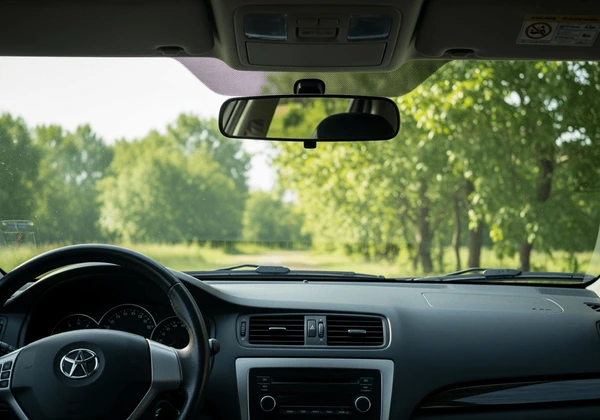
The road ahead is barely visible except for the narrow path lit by your headlights. Then suddenly, a vehicle pulls in behind you, and its powerful LED lights explode across your rearview mirror.
The glare can feel overwhelming, washing out your vision and making it harder to focus on the road in front of you. What many drivers still don’t realize is that most cars already come with a simple built-in feature designed specifically to reduce that problem.
Hidden beneath the rearview mirror is a tiny tab that can dramatically cut down harsh light from vehicles behind you. It usually sits along the bottom edge of the mirror and often goes unnoticed for years. A quick flip is all it takes to soften intense headlight glare and make nighttime driving far more comfortable.

How The Dimming Works
When the tab is moved, the mirror slightly changes its angle. Some mirrors use a push-and-pull motion while others flip upward or downward, but the effect is the same. You may hear or feel a small click when it switches into night mode.
At first glance, the change can seem minor. But once bright headlights hit the mirror, the difference becomes obvious. Instead of reflecting intense white light directly into your eyes, the mirror dims the glare enough to make it manageable.
The reason comes down to how the mirror is built. Rearview mirrors use a wedge-shaped piece of glass with reflective surfaces on both the front and back. In normal daytime mode, you see the brighter reflection from the back layer. In night mode, the mirror shifts so your eyes catch the much weaker reflection from the front surface instead.
That front layer reflects only a tiny percentage of incoming light compared to the stronger rear reflection. The result is a darker image that still lets you see traffic behind you without being blinded.
The system is surprisingly old-school. Manual dimming mirrors have existed since the early 20th century and became common in vehicles decades ago. Despite modern technology, the design remains popular because it works reliably without electronics, sensors, or batteries.
It can feel strange at first because vehicles behind you may appear dimmer and slightly farther away. But many drivers quickly adapt, especially on highways where bright LED headlights can temporarily ruin visibility.
When to Switch Back at Night
A lot of people either forget the feature exists or leave the mirror dimmed all the time. Neither is ideal.
The best approach is to use it only when glare becomes a problem. On brightly lit city streets, the dim setting often isn’t necessary because surrounding light already reduces contrast. But on dark roads and highways, especially when large SUVs or trucks sit behind you with intense headlights, flipping the tab can make a major difference.
Drivers sometimes notice lane changes feel unusual at first because depth perception shifts slightly in dim mode. Even so, many prefer that adjustment over dealing with blinding glare that can affect vision for several seconds.
Headlight brightness has become a growing complaint over the years. As automakers moved from traditional halogen bulbs to LED and HID lighting systems, nighttime glare complaints increased significantly. Many modern vehicles also sit higher off the ground, placing headlights directly into rearview mirrors.
When Driving Dimmed Becomes Dangerous
While the dimmed mirror helps on highways, it is not always useful in tight spaces or parking situations.
Backing out of parking spots with the mirror still dimmed can make objects harder to judge. Curbs, shopping carts, poles, and low barriers may appear less visible than they actually are. The same issue happens when parallel parking or maneuvering through crowded parking garages.
That is why drivers should always switch the mirror back to normal mode before reversing or parking.
It is also important not to leave the mirror dimmed during daytime driving. A darker reflection reduces awareness of nearby traffic and can make lane changes less safe.
Electrochromic Mirrors Automate This
Newer vehicles often eliminate the manual tab entirely by using automatic dimming technology.
Jacob Rabinov sits in his office before a wall of bookshelves in this 1950s black and white photograph. The inventor wears glasses and a dark suit with a light colored shirt. His photocell device automatically adjusted car mirrors to reduce headlight glare at night.
Jacob Rabinow’s 1950s invention used a photocell to automatically tilt and dim car mirrors in response to headlight glare. Image by: National Institute of Standards and Technology, via Wikimedia Commons
Inventors began experimenting with automatic glare reduction back in the 1950s. Early systems relied on photocells and tiny motors that adjusted the mirror whenever bright light was detected from behind.
Eventually, manufacturers developed a more advanced solution known as electrochromic dimming. Instead of mechanically tilting the mirror, these systems use a special gel placed between layers of glass. When electricity passes through the material, the mirror gradually darkens.
Sensors monitor both ambient light and glare from behind the vehicle. If another car’s headlights become too bright, the mirror automatically adjusts itself. Once the glare disappears, it slowly returns to normal brightness.
By the 2010s, automatic dimming mirrors had become common in many mid-range and luxury vehicles. Some systems even connect to the side mirrors so all three dim together.

How to Know If Yours Is Automatic
The easiest way to tell is by looking for the manual tab. If there is no flip lever beneath the mirror, the vehicle likely uses an automatic dimming system.
A driver’s eyes reflected in a car’s rearview mirror at dusk, with blurred city lights visible through the windshield. The mirror displays a small green indicator light for its auto-dimming feature.
A small LED on an automatic mirror glows to show the dimming system is active. Image by: Unsplash
Many automatic mirrors also include a small LED indicator, usually glowing green or amber near the bottom edge. Some display the word “AUTO” directly on the mirror surface.
Drivers can test the feature by shining a flashlight toward the mirror from the back seat. If the glass darkens after a few seconds, the system is working correctly.
Certain vehicles also allow sensitivity adjustments through dashboard settings or buttons on the mirror itself, giving drivers control over how aggressively the dimming reacts.
Buttons Instead of Tabs on Some Models
Some luxury brands introduced a middle ground between manual and fully automatic systems.
Car rearview mirror in automobile. Vehicle interior with rear view mirror and windshield – car salon concept. Auto dim button. Auto dimming button. Details interior closeup.
Instead of a flip tab, these vehicles use a button that activates a small motor inside the mirror. Pressing it shifts the mirror into night mode automatically, often with a soft mechanical sound.
Unlike fully automatic mirrors, however, the driver still decides when to activate it.
How Automatic Mirrors Came to Exist
Before electronic systems existed, drivers relied entirely on manual mirror adjustments to manage glare. The process worked, but it required constant attention whenever bright headlights appeared behind the vehicle.
In the early 1980s, automakers began experimenting with light sensors connected to small motors that adjusted mirrors automatically. While effective, these early systems were expensive and mechanically complex.
A major breakthrough arrived when chemists developed electrochromic gel technology. Instead of moving parts, the mirror itself could darken electronically. Gentex Corporation later refined the design into a commercially successful product.
The first electrochromic mirrors appeared in luxury vehicles during the late 1980s before gradually spreading across the automotive industry throughout the 1990s and 2000s.
The Design Flaw That Ruined Interiors
Not every automatic mirror design aged well.
Some mirrors produced in the late 1990s and early 2000s developed seal failures over time. Once the protective seals weakened, the electrochromic gel inside the mirror could begin leaking.
In some vehicles, the liquid created dark spots or bubbles inside the glass. In worse cases, it dripped onto dashboards and center consoles, damaging plastic trim and interior surfaces.
Manufacturers eventually improved the materials and sealing methods, making modern auto-dimming mirrors far more reliable than earlier generations.
Drivers with older vehicles should pay attention to bubbling, discoloration, or mirrors that remain permanently dark, as these can be signs the internal gel is failing.

The One Maintenance Tip Worth Remembering
Even the best dimming mirror becomes difficult to use if it is dirty.
Fingerprints, smudges, and dust scatter incoming light and reduce visibility, especially at night. Manual mirrors are particularly sensitive because nighttime mode relies on the weaker front reflection of the glass.
Experts recommend cleaning mirrors with a microfiber cloth and a gentle glass cleaner designed for mirrors. Spraying cleaner directly onto the mirror is not ideal because moisture can seep behind the glass and damage internal components.
Using ammonia-based cleaners should also be avoided since they may damage reflective coatings over time.
A clean rearview mirror may seem like a small detail, but during nighttime driving, it can make a noticeable difference when bright headlights suddenly appear behind you.