I Raised My Three Girls Alone After Their Mother Died, Then a Letter Arrived on Their 16th Birthday

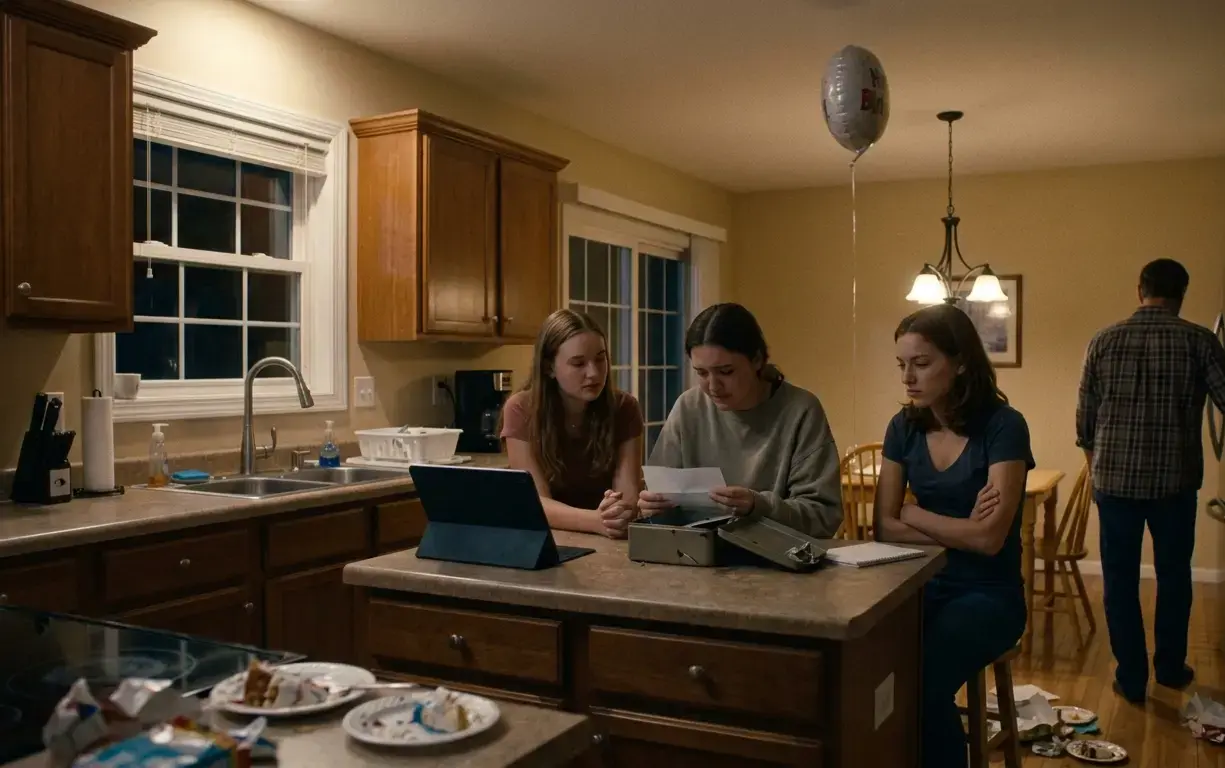
The kitchen still smelled like vanilla cake.
Pink frosting had dried along the edges of paper plates, half-empty cups covered the counter, and one silver birthday balloon had drifted up near the ceiling. Every few seconds, it scraped softly against the light fixture.
It was past midnight, but I wasn’t tired.
At least, that was what I told myself.
I stood at the sink washing glasses that were already clean, listening to the silence that always followed a busy house. A few hours earlier, music had been playing. The girls had been laughing, arguing over pictures, and accusing one another of stealing the best pieces of cake.
Now they were sixteen.
All three of them.
I looked toward the ceiling and pictured Sarah standing beside me. She would have cried through the whole party. She cried at commercials, school concerts, and once when Maya learned to tie her shoes.
“You should’ve seen them tonight,” I whispered. “Nora sang in front of everyone. Can you believe that?”
The refrigerator hummed behind me.
Fourteen years had passed since Sarah died, but some nights I still spoke to her as if she had only stepped into another room.
The girls were two when it happened. They didn’t remember her voice or the way she tapped her fingernails against coffee mugs when she was thinking. Most of what they knew about their mother came from the stories I told them.
I had spent fourteen years trying to give them enough stories.
There was Maya, the oldest by eleven minutes, who asked questions until she reached the truth. Ellie was softer, but only until someone she loved was hurt. Nora pretended not to care about anything, which usually meant she cared more than the rest of us combined.
Raising three daughters alone had not been graceful.
I worked double shifts at the plant when they needed braces. I learned how to braid hair from a woman on YouTube who kept telling me to “divide the section evenly.” My sections were never even.
Maya tolerated my attempts. Ellie demanded pigtails because they were harder to ruin. Nora refused to let me touch her hair at all until she was nine.
There were mornings when all three girls were crying, one shoe was missing, and I had no idea whether the lunch boxes contained the right food. I once sent Maya to school with three yogurts and no spoon.
Still, we survived.
More than that, we became a family with our own strange system.
Whenever the girls asked how their mother died, I repeated what the police had told me. Sarah had been driving during a severe storm. Her car went off the road near the river. The water had risen quickly, and the current was too strong.
They found the car.
They found her jacket, her purse, and her wedding ring inside it.
They never found her body.
For weeks, volunteers searched the riverbanks. Months later, after every lead had gone cold, a court declared her dead.
I believed it.
I had to.
The alternative was waking every morning and wondering whether she was still out there somewhere.
I kept the few things I had left of her inside a metal lockbox in the attic. It held her wedding-day locket, a dried corsage, old letters, and the ultrasound photograph from the day we learned we were having triplets.
The technician had circled three tiny shapes.
Sarah had taken my hand and whispered three names into my palm.
Maya, my Bug.
Ellie, my Bean.
Nora, my Little Bird.
No one else had heard her.
I rarely opened that box. Grief was easier to manage when it had a lid.
I lifted an empty glass toward the ceiling.
“To sixteen,” I said. “You missed a good one.”
A floorboard creaked above me.
Then came the sound of footsteps moving down the stairs.
“Someone still awake?” I called.
No answer.
I dried my hands and turned, expecting Ellie to be looking for cake.
Maya stood in the kitchen doorway.
She was barefoot, wearing sleep shorts and an oversized sweatshirt. Her face looked pale beneath the light.
In both arms, she held the lockbox.
The brass latch had been broken off. Deep scratches ran across the front.
For a few seconds, neither of us spoke.
“Maya,” I finally said. “What are you doing with that?”
She looked down at the damaged box.
“I used a screwdriver.”
Her voice was quiet.
“I’m sorry.”
In one hand, she held a white envelope.
Something about it made my stomach tighten before I even saw the writing.
She walked to the island, set the box down, and pushed the envelope toward me.
Her eyes were red.
“This came today,” she said. “I took it from the mailbox before you got home.”
I stared at the envelope.
The handwriting looked familiar.
Too familiar.
“Maya, where did this come from?”
She tapped the return address.
“It says it’s from Mom.”
My hands went cold.
“That isn’t possible.”
“That’s what I thought.”
She pointed toward the postmark.
“It was mailed Tuesday.”
I picked it up, but my fingers had gone numb. Sarah’s handwriting had always leaned slightly to the right. She made her capital letters too large and never closed the top of the number four.
This envelope had both.
“You told us she died fourteen years ago,” Maya said.
“I told you what happened.”
“No. You told us she was dead.”
“I believed she was.”
Maya’s chin trembled.
“Then open it.”
I couldn’t.
The envelope felt heavier than paper should feel.
Maya pulled it from my hand, tore across the top, and removed a folded page.
“Wait,” I said.
She ignored me.
Her eyes moved across the first sentence. Then she looked up.
“What does it say?” I asked.
Maya swallowed.
“My girls, I don’t know if your father will let you read this, but you deserve to know that I’m alive.”
The room seemed to shift.
I grabbed the counter.
“That’s not funny,” I said, though no one had laughed.
Maya kept reading.
“I was very sick after you were born. I believed you would be safer and happier without me. Maya, my Bug. Ellie, my Bean. Nora, my Little Bird. Those were the names I whispered into your father’s hand when we saw three hearts on the ultrasound.”
Maya stopped.
She didn’t need to ask whether those words were real.
No one knew about that moment.
No one.
“Keep going,” I said.
She wiped her face with her sleeve.
“I planned to return after a few weeks. I was frightened and ashamed, and each day I waited made it harder to come back. On the night of the storm, I pushed the car down the embankment. I left my jacket, purse, and ring inside. Then I walked through the trees and left town.”
I sat down because my legs were no longer holding me.
Maya continued.
“I told myself I would contact you when you were old enough to decide whether you wanted me in your lives. I chose your sixteenth birthday. If you want to meet me, my address is written on the envelope.”
She lowered the page.
For one long moment, all I could hear was the balloon scraping against the ceiling.
“Dad,” Maya whispered, “did you know?”
“No.”
The word came out before she finished asking.
“I swear to you, I didn’t know.”
Footsteps sounded in the hall.
Ellie appeared first, rubbing her eyes. Nora followed behind her.
“What’s happening?” Ellie asked. “Why are you crying?”
Maya handed her the letter.
Ellie read quickly at first, then more slowly. Nora leaned over her shoulder. When they reached the part about the storm, Ellie covered her mouth.
“This isn’t real,” Nora said.
No one answered.
“Dad,” Ellie said, “tell us that isn’t her handwriting.”
I looked at the page.
I wanted to lie.
For the first time in fourteen years, I wanted to give them anything but the truth.
“It’s hers.”
Nora lowered herself onto a stool.
“You knew she was alive.”
“No.”
“You expect us to believe that?”
“I identified what they found in the car. Her ring. Her purse. Her jacket. The police told me the river took her.”
“You had a funeral,” Maya said.
“A memorial. We didn’t have a body.”
“And you never questioned that?”
“Every day.”
My voice rose more than I intended.
“Do you think I didn’t wonder? Do you think I didn’t stand near that river and imagine her calling for help? They searched for weeks. They showed me reports. They gave me a death certificate.”
The girls fell silent.
I looked again at the address. It belonged to a town six hours away.
“I’m going there,” I said.
“We’re coming,” Ellie replied.
“No.”
All three started speaking at once.
“Listen to me,” I said. “I need to know who is at that address. I need to know whether this is real before you walk into something you can’t undo.”
Maya folded her arms.
“If she’s really our mother, we have a right to be there.”
“You do. But I’m asking for one day.”
Nora stared at the floor.
“What happens if it’s her?”
I didn’t have an answer.
“I’ll call you.”
I left before sunrise.
For six hours, I drove through towns I had never noticed before. I rehearsed what I would say. Every version sounded wrong.
I imagined screaming at her. I imagined walking away without speaking. At one point, I imagined seeing a stranger open the door and feeling relieved.
The town was smaller than I expected. The address led to a modest house at the end of a quiet street.
I parked across from it and sat in my truck for twenty minutes.
Finally, I crossed the road.
The door opened after my second knock.
Sarah stood there.
Her hair was shorter. Gray ran through the dark strands near her temples. Her face was older, of course, but unmistakable.
For fourteen years, I had tried to remember her clearly.
Now she was standing three feet away.
“David,” she said.
I couldn’t speak.
She stepped aside.
I entered because I didn’t know what else to do.
The house smelled like coffee and laundry detergent. A pair of reading glasses rested beside a stack of books. There were plants near the window and photographs on the mantel.
A whole life.
She had built a whole life while I was teaching our daughters to ride bicycles and staying awake through fevers.
“You wrote to them,” I said.
“Yes.”
“Why now?”
“They turned sixteen.”
“That isn’t an answer.”
She folded her arms tightly.
“It was the age I chose a long time ago.”
“You chose?”
“I thought they should be old enough to decide for themselves.”
I laughed once, but there was nothing funny in it.
“You staged your death, left me with three toddlers, and now you’re concerned about giving people choices?”
Her face tightened.
“I know how that sounds.”
“You don’t know anything about how it sounds.”
She sat down.
“After the girls were born, I wasn’t well.”
“Neither was I.”
“I had postpartum depression. I barely slept. I became convinced I was dangerous to them.”
“Did you hurt them?”
“No.”
“Did you try?”
“No.”
“Then why didn’t you ask for help?”
“I thought leaving was help.”
“That makes no sense.”
“I know.”
Her answer came so quietly that it stopped me.
Sarah looked down at her hands.
“I planned to return after a few weeks. Then I imagined what you would say. What everyone would say. Weeks became months. Eventually, I didn’t know how to come back without destroying all of you.”
“So you let us believe you were dead.”
“Yes.”
I paced toward the window.
“You let me tell our daughters their mother drowned.”
Tears filled her eyes.
“I know.”
“You don’t get to cry about this.”
She wiped them away.
“You’re right.”
I turned toward her.
“Come with me.”
She looked up.
“Come home. Get in the truck and face them.”
Sarah shook her head.
“No.”
My anger came back at once.
“You don’t get to refuse.”
“I’m not walking into their house unless they ask me to.”
“They’re sitting there waiting for answers.”
“And they might not want me.”
“You wrote the letter.”
“I gave them the choice.”
“You lit a match and mailed it to three children.”
“If I show up without permission, I take another choice away from them. I already did that once.”
I wanted to argue, but the words caught in my throat.
The worst part was that she wasn’t completely wrong.
“Have you seen them?” I asked.
Sarah went still.
“What do you mean?”
“You knew they turned sixteen. You knew where we lived.”
“I knew some things.”
“How?”
She looked toward the mantel.
That was when I saw the photograph.
The girls were twelve, sitting together on a picnic blanket. Maya was laughing. Ellie was shielding her eyes from the sun. Nora was making a face at the camera.
I had that same photograph at home.
Rachel had taken it.
I lifted the frame.
“Where did you get this?”
Sarah said nothing.
“Where did you get it?”
“Rachel sent it.”
I stared at her.
“My sister?”
“She found me six years ago. We ran into each other at a rest stop.”
The frame nearly slipped from my hand.
“Rachel knew?”
“She wanted to tell you.”
“But she didn’t.”
“I asked her not to.”
“You asked her?”
“I thought knowing would break you.”
I set the frame down carefully.
Memories began rearranging themselves.
Rachel volunteering to take pictures at every birthday. Rachel asking strangely specific questions about the girls. Rachel going quiet whenever Sarah’s name came up.
Six years.
My own sister had known for six years.
“She sat beside me at school plays,” I said. “She watched me talk about you like you were dead.”
“Don’t blame her.”
I looked at Sarah.
“That may be the most selfish thing you’ve said today.”
I left before she could answer.
The drive home blurred.
I had grieved Sarah, but Rachel’s betrayal felt different. Sarah had disappeared from my life. Rachel had stayed in it. She had eaten at my table, helped with homework, and listened to the girls talk about the mother they believed was gone.
She knew.
I drove straight to her house.
Rachel opened the door before I knocked twice.
She was already crying.
“You knew,” I said.
She nodded.
“How long?”
“Six years.”
I stepped back as if she had struck me.
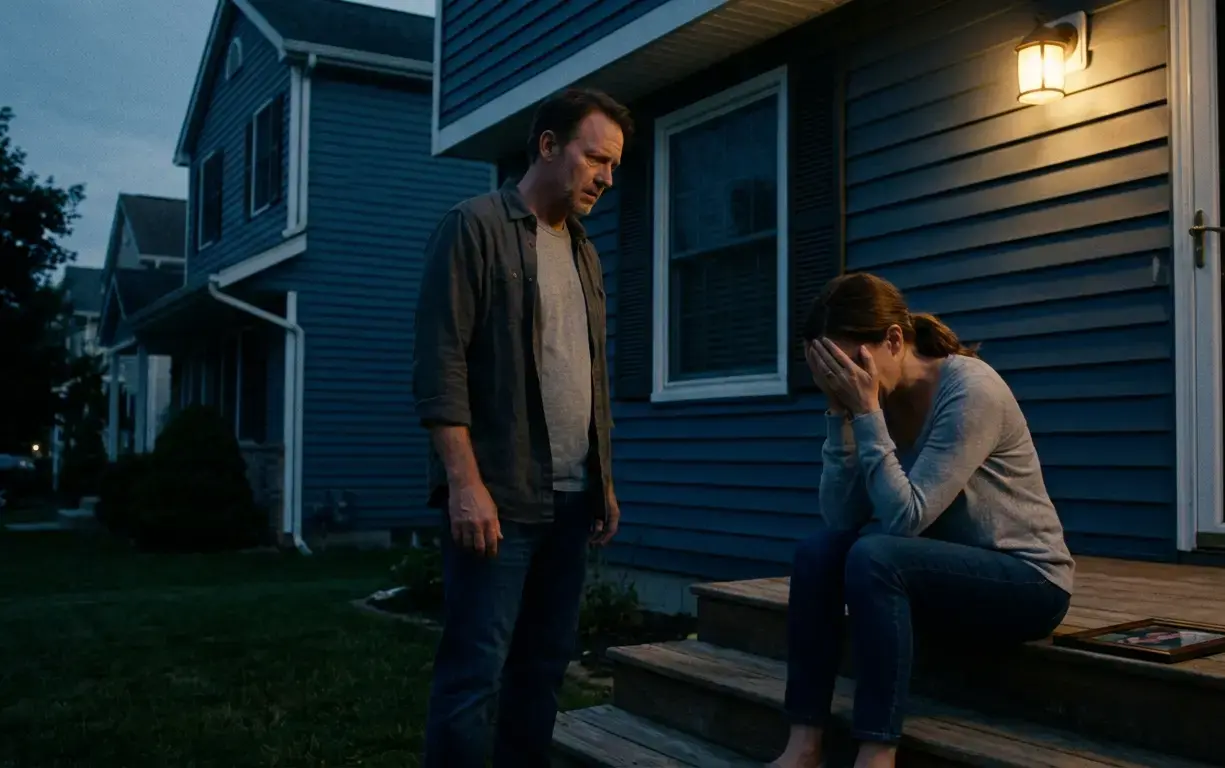
Rachel sat on the porch step.
“I saw her at a rest stop. I thought I was imagining it. She begged me not to tell you.”
“And that was enough?”
“No.”
“Then why?”
“You were barely holding yourself together, David.”
“I raised three children.”
“I know.”
“No, you watched.”
She covered her face.
“I thought if I told you, you’d fall apart. I thought the girls might lose the only parent they had.”
“That wasn’t your decision.”
“I know that now.”
I wanted to hate her.
Part of me did.
But she looked smaller than I had ever seen her, sitting beneath that porch light.
“If you want to stay in our lives,” I said, “you’ll have to earn your way back.”
Rachel nodded.
“I will.”
When I returned home, the girls were waiting in the living room.
None of them had slept.
I told them everything. I told them about Sarah, the house, the depression, the photographs, and Rachel.
When I finished, no one spoke for a while.
Then I asked the only question that mattered.
“What do you want to do?”
Maya answered first.
“We meet her.”
Ellie reached for my hand.
“Together.”
Nora stared at the letter.
“I’ll go,” she said. “But I’m not calling her Mom.”
“That’s your choice,” I replied.
She nodded.
Then all three girls moved toward me at once.
I held them the way I had when they were little.
And for the first time, I didn’t hide my grief upstairs.
I let them see it.
Months later, I stood at the same kitchen sink, washing dishes while the girls laughed around the table.
Sarah’s face appeared on a laptop screen. They were on a video call, still careful around one another, still learning where the boundaries were.
Nora called her Sarah.
Ellie asked questions.
Maya listened for the truth beneath every answer.
Rachel and I had started speaking again, though forgiveness was coming slowly.
I had also started therapy.
For years, I believed protecting my daughters meant carrying every painful thing by myself. I was wrong.
The truth did not repair everything.
It did not return fourteen years or erase what Sarah and Rachel had done. It did not make us one happy family.
But it gave the girls something the lie never could.
A choice.
I used to think the life we built was beautiful because I had protected it from the truth.
Now I understood something else.
A beautiful lie can hold a family together for a while.
Only the truth gives them a chance to heal.