Mother Disappeared for 7 Years and I Became Guardian of Her 10 Kids, Then Eldest Daughter Confessed

Years after their mother disappeared, I became the legal guardian of my late fiancée’s ten children, but my oldest finally sat me down and said something I never imagined I’d hear.
“Dad… I think you’re ready to know what really happened to Mom.”
For seven years, I believed I understood the worst day of our lives.
I thought I knew exactly how we had lost Calla.
I thought we were all carrying the same grief.
Turns out, I had been grieving a version of the story that never existed.
It happened on an ordinary Tuesday evening. Nothing about that day hinted that my entire life was about to be turned upside down.
I was folding towels in the laundry room when Mara, my oldest, quietly stepped inside and closed the door behind her.
She looked nervous. Older than her years.
Then she told me the truth she had been carrying since she was eleven years old.
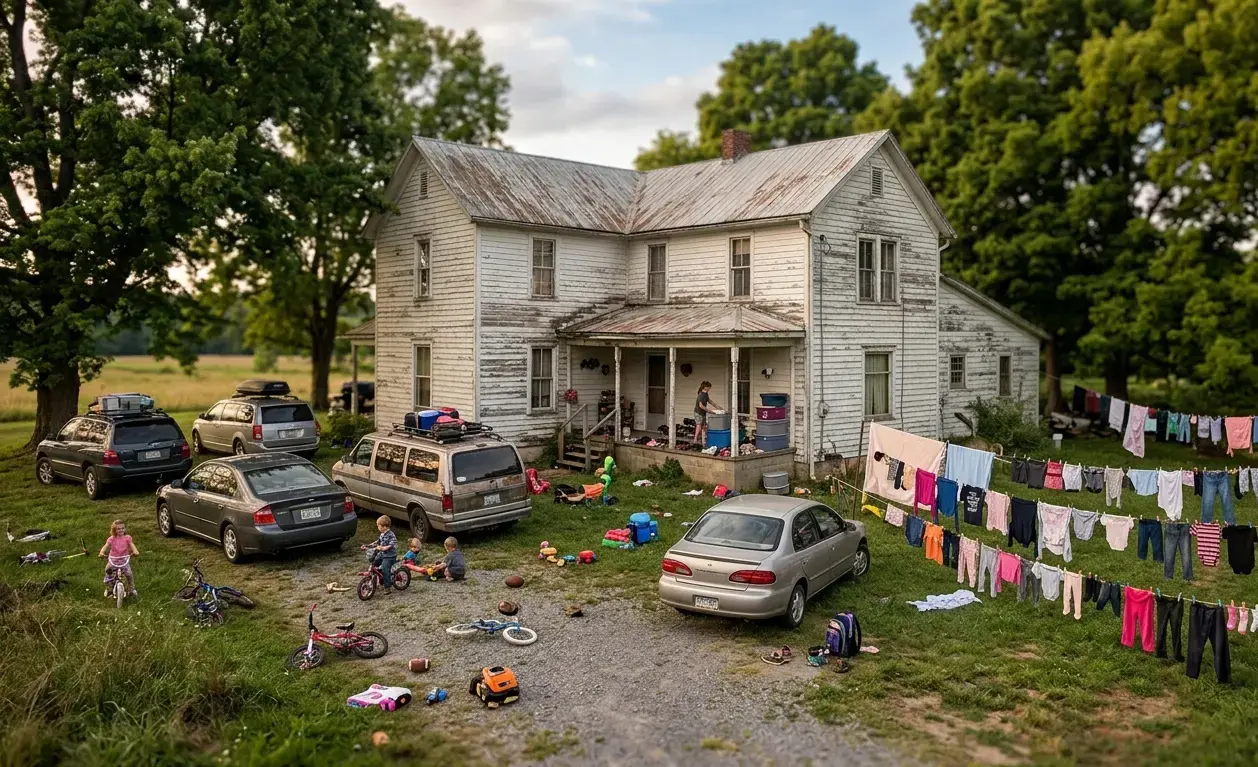
Most mornings in our house feel like controlled chaos.
By seven o’clock, something has already gone wrong.
One kid can’t find their backpack. Someone burns breakfast. Somebody else is crying because their favorite shirt is still in the washing machine. That particular morning, it was burnt sourdough, three missing left shoes, and two of the boys arguing over a single Lego brick like it was worth a fortune.
I’ve gotten used to it.
I’m forty-four now, and for the past seven years I’ve been raising ten children on my own.
Not one of them is biologically mine.
People always pause when I tell them that.
Then they usually ask why.
The answer has never changed.
Because they were Calla’s children.
And because after their mother disappeared, there wasn’t anyone else who was going to keep them together.
Life in this house is loud from sunrise until everyone finally collapses into bed. There’s always a permission slip waiting to be signed, someone needing help with homework, a scraped knee that suddenly feels like an emergency, or another basket of laundry that somehow appeared out of nowhere.
Sometimes I wonder what silence even sounds like anymore.
Then one of the kids yells from upstairs, and I remember it doesn’t really matter.
This is home.
Exhausting, messy, unpredictable home.
Calla had a gift that I never did.
She could calm a room without saying very much.
The younger kids adored her. The older ones listened when she spoke. Even when life got stressful, she somehow made everything feel manageable.
Looking back now, I realize how much I leaned on her.
I thought we’d grow old together.
I had already pictured the wedding.
None of us imagined that everything would fall apart first.
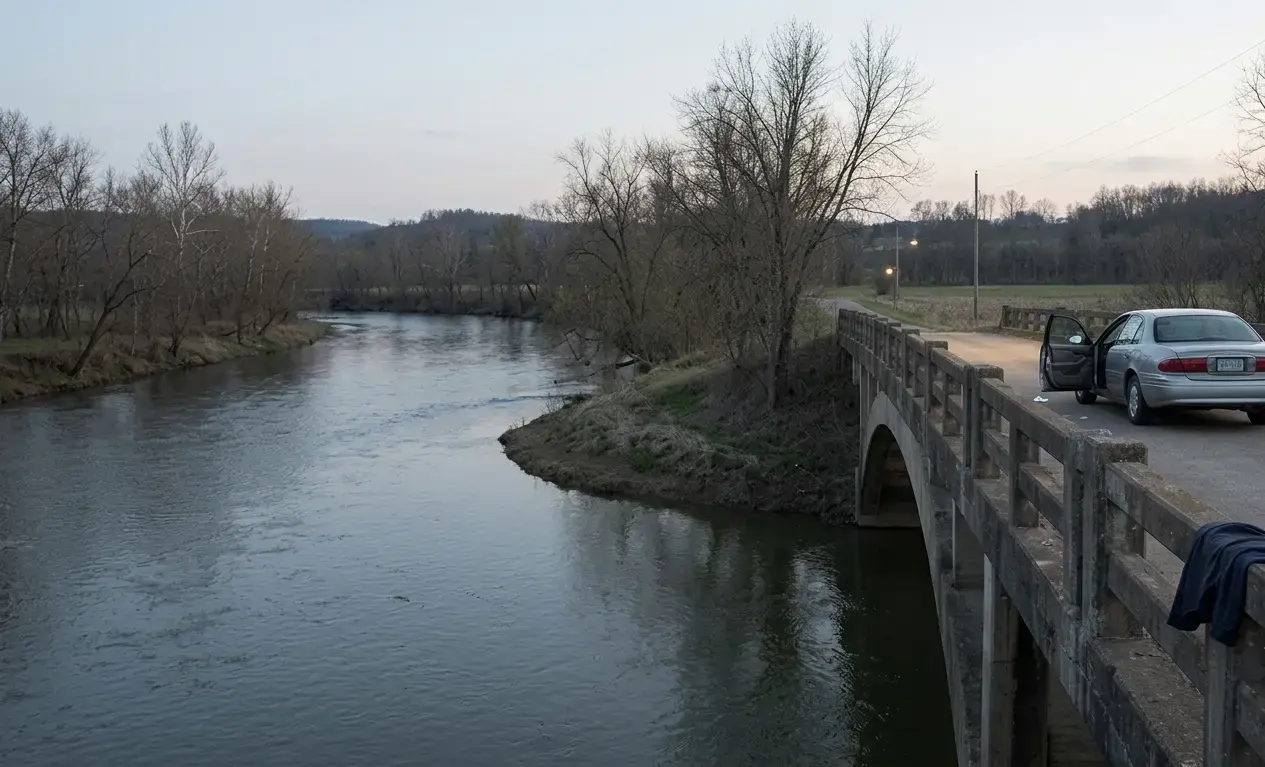
Seven years ago, the police found her car parked beside the bridge that crossed the river outside town.
The driver’s door was open.
Her purse was still sitting on the passenger seat.
Her coat had been folded neatly on the railing overlooking the water.
Nothing about the scene made sense.
It looked carefully arranged, almost like someone wanted it to tell a specific story.
But when something tragic happens in a small town, people don’t wait for answers.
They create their own.
Rumors spread faster than facts ever do.
Within days, everyone had already decided what must have happened.
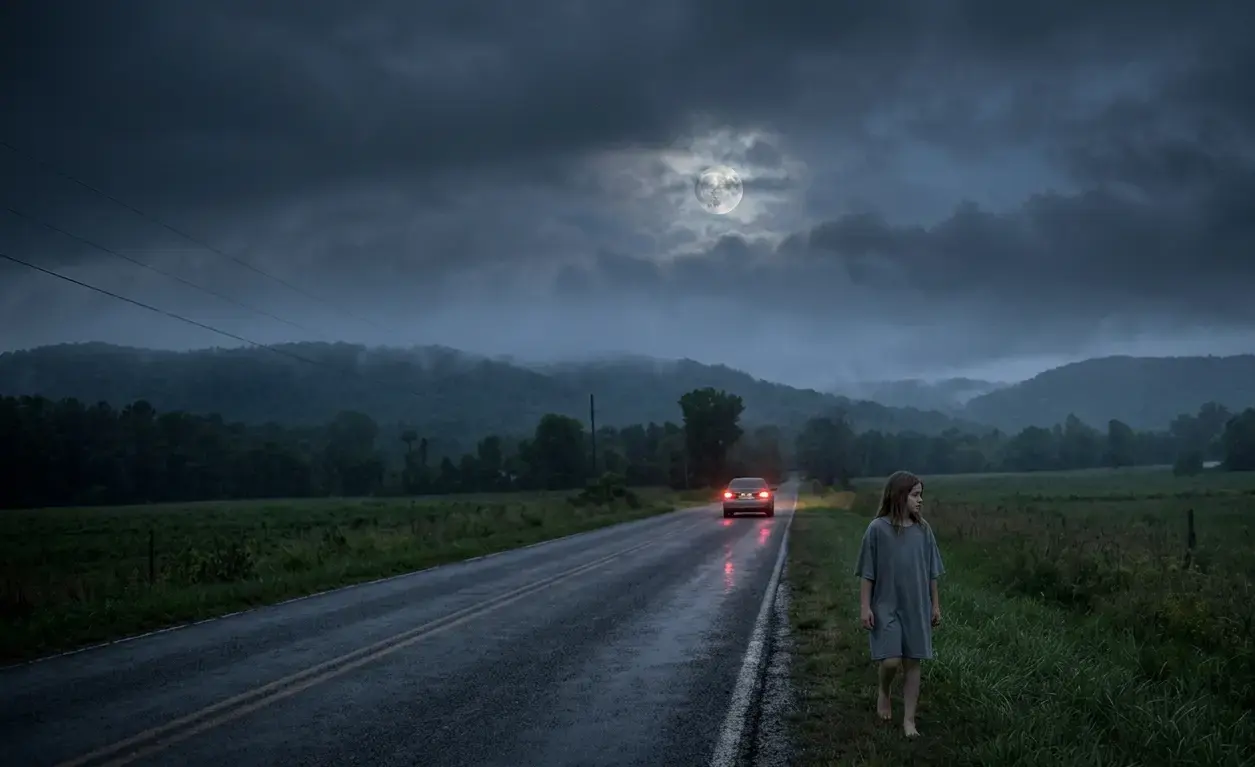
Mara was found a few hours later.
She had wandered miles away from the bridge before anyone spotted her walking barefoot along the side of a quiet road.
She was soaked, shivering, and completely disoriented.
The officers who found her said she barely reacted when they spoke to her.
For weeks after that, she answered every question exactly the same way.
“I don’t remember.”
At first everyone assumed it was trauma.
Eventually, even she seemed to believe it.
Search crews spent ten days looking through the river.
Divers searched every section they could reach.
Helicopters circled overhead.
Volunteers combed the banks.
Nothing.
No body.
No answers.
Eventually the search ended.
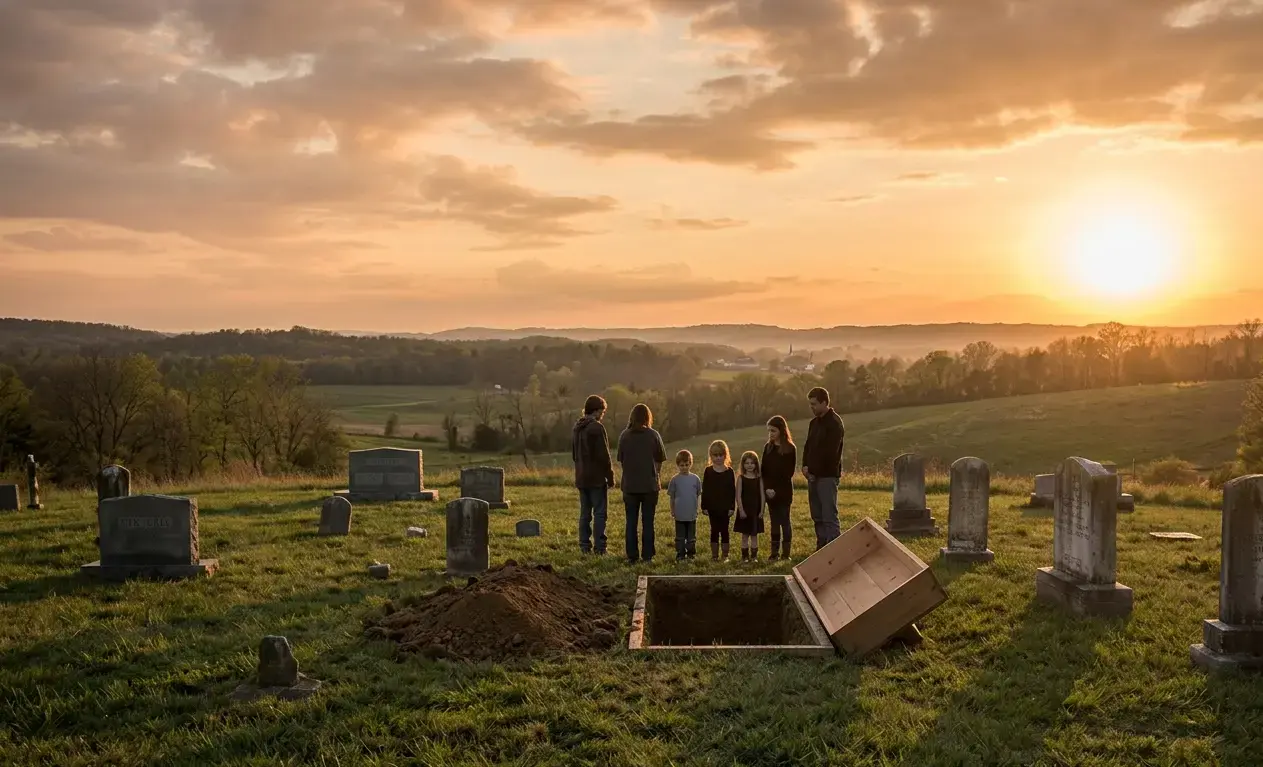
The town held a funeral anyway.
We buried an empty coffin because there was nothing else to bury.
That was the day I convinced myself life would never look normal again.
People thought I’d lost my mind when I decided to raise all ten kids.
Some tried to be supportive.
Others were more blunt.
My brother was one of them.
He invited me over one evening, handed me a beer, and waited until we were sitting outside before saying what everyone else had been thinking.
“You can’t do this by yourself.”
He wasn’t trying to be cruel. He was worried.
“You loved Calla. Nobody doubts that,” he said. “But ten grieving children? That’s more than one person can handle.”
At the time, I brushed it off.
Looking back, I understand why he said it.
There were nights when the washing machine seemed to run without ever stopping. I’d be folding tiny shirts at two in the morning, knowing I’d have to be up again before sunrise. Bills stacked up on the kitchen counter. Someone always had a doctor’s appointment. Somebody else had a school project due the next morning that they’d forgotten to mention until bedtime.
I was constantly tired.
Not the kind of tired a good night’s sleep fixes.
The kind that settles into your bones.
But every time I questioned whether I was enough, I’d hear little footsteps coming down the hallway or someone quietly asking if I could tuck them in.
Walking away was never an option.
Those kids had already lost one parent.
I wasn’t about to become the second.
So we kept moving.
One birthday after another.
School concerts.
Soccer games.
Dentist appointments.
Flu season.
Christmas mornings that felt a little emptier every year, but were still filled with wrapping paper and laughter because the children deserved that much.
Life didn’t become easier.
We simply learned how to carry it.
A few weeks ago, something changed.
It wasn’t dramatic.
It started with a simple question.
We were making lunches before school, passing bread, fruit, and juice boxes down the kitchen counter like an assembly line.
Mara looked up from what she was doing.
“Dad… can we talk later?”
“Sure,” I answered.
She nodded, but there was something different about her expression.
It wasn’t sadness.
It wasn’t fear.
It was determination.
She looked like someone who had rehearsed a difficult conversation a hundred times but still didn’t know how to begin.
I couldn’t stop thinking about it for the rest of the day.
I figured she wanted to talk about Calla.
Maybe she’d found old photos.
Maybe she wanted to visit her mother’s favorite places.
Maybe she simply missed her.
None of those guesses came close.
That night, after the younger kids were asleep and the house had finally quieted down, Mara found me folding towels in the laundry room.
She closed the door behind her.
For a few seconds, she just stood there.
I waited.
Finally, she took a deep breath.
“Dad…”
Her voice barely rose above a whisper.
“I need to tell you something.”
I smiled, trying to make it easier for her.
“You can tell me anything.”
She looked down at the floor.
Then she said the sentence that completely shattered everything I’d believed for seven years.
“You’ve been told the wrong story.”
I frowned.
“What do you mean?”
She looked me straight in the eye.
“Mom didn’t jump.”
I didn’t answer.
Honestly, I couldn’t.
It felt like my brain had stopped working.
She continued before I could even process what she’d said.
“She didn’t fall into the river either.”
Another long pause.
Then she quietly added,
“She left.”
Those two words hit harder than anything I’d experienced since the day Calla disappeared.
For a moment I wondered if Mara had somehow convinced herself of something that wasn’t true.
Children sometimes create memories to cope with trauma.
Maybe this was one of those situations.
Then she started telling me details.
Specific details.
Things only someone who had been there could know.
And suddenly I realized this wasn’t a theory.
She had been carrying the truth all along.
Slowly, piece by piece, Mara told me what happened that night.
Calla had driven to the bridge on purpose.
She parked the car exactly where everyone would find it.
She left her purse inside.
She folded her coat neatly over the railing.
Everything had been planned.
It was meant to look like a tragedy.
But there was no accident.
No suicide.
No fall into the river.
She turned to Mara before leaving.
According to Mara, Calla admitted she’d gotten herself into financial trouble. There were debts she couldn’t repay and problems she no longer believed she could fix. There was also another man waiting for her.
She told her eleven-year-old daughter she was leaving to start over somewhere else.
Then she said something that still makes me sick whenever I think about it.
She told Mara we’d all be better off without her.
Imagine placing that burden on a child.
Imagine asking an eleven-year-old to carry a secret that would change the lives of an entire family.
Then asking her never to tell anyone.
Mara believed she was protecting everyone.
For seven years she watched us mourn.
She watched her brothers and sisters cry themselves to sleep.
She watched me stand at an empty grave wondering what I could have done differently.
And every single day she stayed silent because she thought that was what her mother wanted.
No child should ever have to live with that.
When Mara finally stopped talking, neither of us said a word.
The room felt impossibly quiet.
I kept replaying the last seven years in my head, trying to fit this new truth into memories that suddenly didn’t make sense anymore.
I’d spent all that time mourning someone who had chosen to disappear.
But somehow, that wasn’t even the part that hurt the most.
What crushed me was picturing an eleven-year-old girl carrying that secret by herself.
She had watched me cry.
She had comforted her younger brothers and sisters.
She had stood beside an empty coffin at her own mother’s funeral knowing there was no body inside.
And every single day she believed staying silent was the right thing to do.
I finally managed to ask the question that had been sitting in my throat.
“Why tell me now?”
Without saying a word, Mara reached into her pocket and unlocked her phone.
She opened a conversation I had never seen before and handed it to me.
My stomach dropped.
Three weeks earlier, Calla had sent her a message.
There was a photo attached.
I barely recognized the woman staring back at me.
Her hair had gone gray around the temples, and the smile I remembered was gone. She stood beside a man I’d never seen before, both of them looking older than their years.
The message underneath was short.
She wrote that she wasn’t well.
She wanted to explain everything before it was “too late.”
She hoped Mara would help her reconnect with the family.
I read it twice.
Then I handed the phone back.
I didn’t feel relief.
I didn’t even feel closure.
Just anger.
A quiet kind of anger that had been buried beneath grief for so many years that I hadn’t realized it was there.
The next morning, I didn’t call Calla.
I called a lawyer.
For once, I needed someone who wasn’t emotionally involved.
I explained everything from the beginning.
The bridge.
The missing body.
The years of raising the children.
Mara’s confession.
The recent message.
She listened without interrupting.
When I finished, she calmly explained where things stood legally.
For seven years, I’d been the children’s legal guardian.
If Calla suddenly wanted back into their lives, it wasn’t as simple as showing up with an apology.
There were legal steps.
Court hearings.
Evaluations.
She couldn’t undo seven years with a single text message.
Hearing that lifted a weight I hadn’t realized I was carrying.
For the first time since Mara spoke, I felt like the children were protected.
Eventually, I agreed to meet Calla.
Not because I owed her anything.
Because I wanted to hear what kind of explanation could justify walking away from ten children.
We met in the parking lot of a small shopping center halfway between our towns.
Neutral ground.
No memories attached.
I recognized her immediately.
She looked older than forty.
Life clearly hadn’t unfolded the way she’d imagined.
For a second, I searched for the woman I used to love.
I couldn’t find her.
She looked familiar.
But she felt like a stranger.
After a few awkward moments, she finally started talking.
She said she’d panicked.
That she’d buried herself in debt.
That everything had become too much.
She said there were mistakes she’d been too ashamed to admit.
Then she looked me in the eye and said something I’ll never forget.
“I left because I knew you’d be a better parent than I could ever be.”
For a moment I honestly wondered if she’d heard herself.
A better parent?
No.
A better parent doesn’t disappear.
A better parent doesn’t let their children believe they’re dead.
And they certainly don’t ask an eleven-year-old to protect that lie for seven years.
There is a world of difference between making a sacrifice and abandoning your family.
She never seemed to understand that.
When I got home, I went straight to Mara.
She looked terrified.
Probably afraid I’d be angry with her.
Instead, I sat beside her.
“You don’t have to carry this anymore,” I told her.
“You never should have.”
The tears came almost instantly.
Not loud sobbing.
Just the kind of crying that comes after holding something inside for far too long.
I wrapped my arms around her while years of guilt finally spilled out.
“It wasn’t your fault,” I kept telling her.
“You were a child.”
“I know,” she whispered.
“But I didn’t back then.”
That evening, I gathered everyone in the living room.
The younger kids sat cross-legged on the floor.
The teenagers leaned against walls and doorframes, already sensing something serious was about to happen.
I told them the truth.
Not every painful detail.
They didn’t need to know about the debts or the other man.
Those belonged to Calla’s story, not theirs.
What they deserved to know was simple.
Their mother hadn’t died.
She had chosen to leave.
And before anyone could react, I made one thing perfectly clear.
“Mara didn’t do this.”
“She was a child who was asked to keep an impossible secret.”
“If anyone here deserves compassion tonight, it’s her.”
The room stayed silent for several seconds.
Then emotions started spilling out.
Some of the older kids were furious.
One stormed outside.
Another cried openly.
The younger ones looked confused more than anything else.
They struggled to understand how someone could simply decide to leave.
But through all of it, nobody blamed Mara.
Instead, one by one, they walked over and hugged her.
Some cried with her.
Others simply sat beside her.
Watching that happen was the first time in years I felt something close to peace.
Not because the truth made things easier.
Because the secret was finally gone.
Later that night, after everyone had settled down, Mara found me sitting on the back porch.
She wrapped herself in a blanket and sat beside me.
After a long silence, she asked quietly,
“What happens if she comes back?”
It was the hardest question of the day.
I looked out into the yard for a long moment before answering.
“Being a mom isn’t something you are because you gave birth once.”
“It’s something you choose every day.”
“It’s the school mornings.”
“The sleepless nights.”
“The doctor’s appointments.”
“The birthdays.”
“The hard conversations.”
“The moments when you’re exhausted but stay anyway.”
I looked at her.
“Your mother gave birth to all of you.”
“That will always be true.”
“But family is built by the people who keep showing up.”
She leaned against my shoulder without saying anything.
Neither of us needed to.
For seven years, we’d believed our family had been destroyed by tragedy.
That night, we finally understood what had really held us together all along.
It wasn’t the person who walked away.
It was the people who stayed.